Last Modified: March 20, 2024, 4:40 p.m.
How the Economy Drives Insurance Cost and its Impact on Employers
By Danone Simpson
Danone Simpson, EMBA, GDBIS, is CEO of Montage Insurance Solutions.
The consumption of insurance through claims and fraud has increased to such an amount that is hemorrhaging our industry, along with the costs we’ve been dealt by the pandemic, acts of God, and fire. The impact is increasing costs for employers and individuals.
According to Coalition Against Insurance Fraud (CAIF), the estimated total loss in insurance fraud are $308 billion. CAIF has concluded that workers’ compensation fraud is $34 billion. California has the highest in workers’ comp premiums written in the United States.
There are different types of fraud, categorized as:
- Claimant fraud – which is the 1.2% of the types of fraud. This is when a claimant makes a false claim, usually a non-work injury claimed to have happened on the job.
- Employer premium fraud – makes up most of the fraud at $122 billion per year. This fraud comes into one of three categories:
- Underreporting the number of employees or wages
- Intentionally misclassified employees’ work
- Experience modification evasion to a lower X-Mod, lower premiums by switching insurance or changing the company’s name or ownership
- Provider fraud – involves misbilling codes, goods and services, upcoding or double billing.
- Agent/broker fraud – harms clients and industry from dishonest brokers through the premium diversion, discovered after an uninsured dies from a policy never put into place, leaving the client holding the bag.
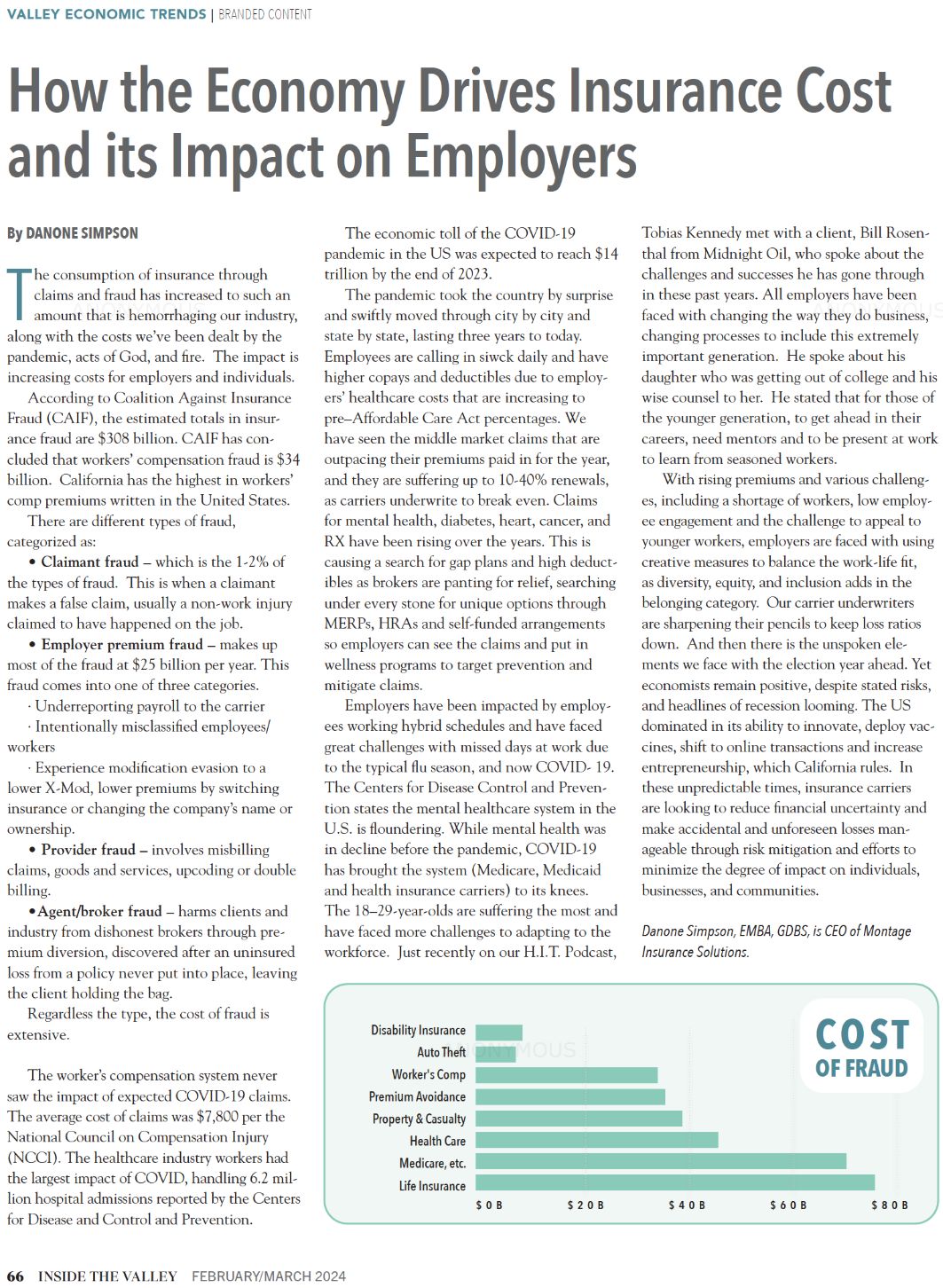
Regardless the type, the cost of fraud is extensive.
The worker’s compensation system never caught up to cover costs of COVID-19 claims. The average cost of claims was $87,000 per the National Council on Compensation Insurance (NCCI). The healthcare industry workers had the highest impact of COVID, hitting 6.2 mil. ER hospitalizations as reported by the Centers for Disease and Control and Prevention.
The economic toll of the COVID-19 pandemic in the US was expected to reach $14 trillion by the end of 2023.
The pandemic took the country by surprise and swiftly moved through city to city and state by state, lasting three years to today. Employees are calling in sick daily and have higher copays and deductibles due to the employers’ healthcare costs that are increasing to pre–Affordable Care Act percentages. We have seen the mid-market clients that are outpacing their premiums paid in for the year, and they are suffering up to 10-40% renewals, as carriers underwrite to break even. Claims for mental health, diabetes, heart, cancer, and RX have been rising over the years. This is causing a snafu for gain plans and high deductibles as brokers are panting for relief, searching under every stone for unique options through MERPs, HRAs and self-funded arrangements so employers can see the claims and put in wellness programs to target prevention and mitigate claims.
Employees have been impacted by employers working hybrid schedules and have faced great challenges with missed days at work due to the typical flu season, and now COVID-19. The Centers for Disease Control and Prevention states the entire healthcare system in the U.S. is foundering. While mental health was in decline before the pandemic, COVID-19 has brought the system (Medicare, Medicaid and health insurance carriers) to its knees.
The 18-29-year-olds are suffering the most and have faced more challenges to adapting to the workforce. Just recently on our H.I.T. Podcast, Tobias Kennedy met with a client, Bill Rosenthal from MidSouth Oil, who spoke about the challenges that small employers have gone through in these past years. All employers have been faced with changing the way they do business, shifting processes to include ethics extremely important generations. He spoke about his daughter who was getting out of college and gave wise counsel to her. He stated that for those of the younger generation, to get ahead in their careers, need mentors and to be present and to learn from seasoned workers.
With rising premiums and various challenges, including a shortage of workers, low employee engagement and the challenge to appeal to younger workers, employers are faced with using creative measures to balance the work-life fit, as diversity, equity, and inclusion lands in the belonging category. Our carrier underwriters are sharpening their pencils to keep loss ratios down. And then there is the unspoken elements we face with the election year ahead. Yet economists remain positive, despite raised risks, and headlines of recession looming. The US is dominated in its ability to innovate, deploy vaccines, shift to online transactions and increase entrepreneurship, which California rules in. In these unpredictable times, insurance carriers are looking to reduce financial uncertainty and make accidental and unforeseen losses more manageable through risk mitigation and efforts to minimize the degree of impact on individuals, businesses, and communities.
Originally Published: May 4, 2025, 4:46 p.m.
By Montage Insurance